

Training built by compliance specialists, not generic content
Every course is written for Australian NDIS and aged care providers and follows the NDIS Practice Standards, the NDIS Code of Conduct and the strengthened Aged Care Quality Standards. Learners practise real situations, so the knowledge carries into the shift.
Learn by doing
Narrated lessons with sorting, sequencing and flip card activities keep every learner engaged.
Real scenarios
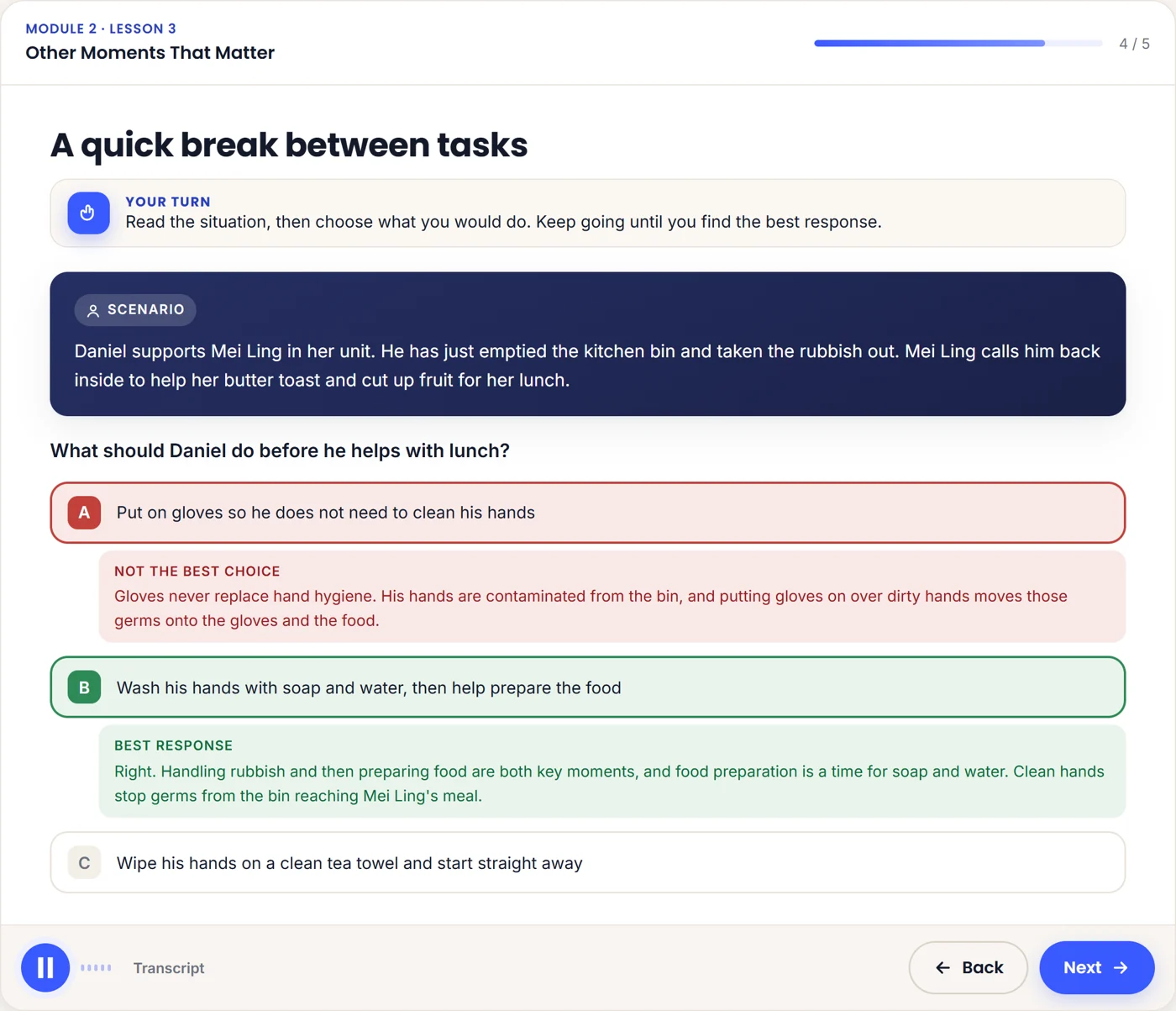
Branching case studies ask what you would do, then explain why the best response is right.
Quizzes and assessment
A quiz closes every module and a shuffled final assessment confirms competency.
Audit ready certificates
Certificates carry a unique ID so auditors and employers can verify them in seconds.
Explore 144 courses
118+ hours of training across 22 topic areas. Single courses are $45 to $55 and yours to keep, or unlock the whole library with All Access for $260 a year.
 50 min
ABC Charts
An ABC chart is a simple tool for recording what happens before, during and after a behaviour of concern. Accurate ABC records help behaviour support practitioners and the wider team understand why a behaviour happens and what the person may be trying to communicate, so supports can be improved and the need for restrictive practices reduced. This course explains what antecedents, behaviours and consequences are, why setting events matter, how to describe each part objectively, and how to complete an ABC chart as soon as possible after an event. Worked examples show poor and improved entries. You will also learn how ABC charts link to behaviour support plans and incident reporting, then apply your skills in two case studies set in disability and aged care. Duration: 50 minutes.
 50 min
Acquired Brain Injury
An acquired brain injury is any damage to the brain that happens after birth, whether from a stroke, a lack of oxygen, an infection, a tumour, alcohol or drug use, or a blow to the head. This course explains what an acquired brain injury is, the many ways it can change how a person thinks, feels, communicates and moves, and practical ways you can support a participant to live the life they choose. It covers fatigue, memory and planning, changed behaviour, communication, mood and working within the support plan. Case studies about a young man returning home and an older woman after a stroke bring it together. The course builds knowledge only: always follow the participant's plan and their health practitioner's advice. Duration: 50 minutes.
45 minActive Support in Everyday Life
Active support is a way of working that helps people take part in the ordinary activities of their own lives, from making toast to catching the bus, rather than watching while staff do things for them. This course explains what active support is and why meaningful engagement matters so much for wellbeing, skills and choice. You will learn to work with people rather than for them, break tasks into manageable steps, give just the right amount of help using graded assistance, and use positive reinforcement. We also cover planning opportunities through the day, recording engagement, and practical examples from home and community settings, along with common barriers and how to overcome them. Duration: 45 minutes.
 45 min
Aged Care Code of Conduct
The Code of Conduct for Aged Care sets out how every aged care worker, provider and responsible person is expected to behave towards the older people we support. This course walks through all eight elements of the Code in plain language, with examples from residential care and care in people's own homes. You will learn who the Code applies to, how to raise concerns early, how whistleblower protections under the Aged Care Act 2024 keep you safe when you speak up, and what the Aged Care Quality and Safety Commission can do when the Code is breached, including banning orders. Two case studies, one in a residential home and one in home care, show how the Code guides everyday decisions. The course finishes with a final assessment. Duration: 45 minutes.
50 minStandard 1: The Individual
Standard 1 of the strengthened Aged Care Quality Standards sets the foundation for how we treat every older person we support. The Aged Care Quality and Safety Commission now names it The individual, and it applies to home, community and residential services. This course explains the four outcomes in plain language: person centred care, dignity, respect and privacy, choice, independence and quality of life, and transparency and agreements. You will see what each outcome looks like on an ordinary shift, and learn when to speak up and tell your team leader. Three case studies follow a resident settling into care, a man travelling home for a funeral, and a client confused by a new agreement. Duration: 50 minutes.
50 minStandard 2: The Organisation
Standard 2 of the strengthened Aged Care Quality Standards is about how an aged care organisation is run. It makes the governing body responsible for safe, quality care, but every worker helps the systems work. This course explains the ten outcomes in plain language, grouped into what they mean for you: partnering with older people, a culture of quality and safety, managing risk and incidents, welcoming feedback and complaints, handling information properly, having a skilled workforce, and being ready for emergencies. You will learn practical examples, such as reporting a near miss, writing clear notes and knowing your part in an emergency plan. Three case studies follow a fall in residential care, feedback from a client at home and a storm warning in the community. Duration: 50 minutes.
45 minStandard 3: The Care and Services
Standard 3 of the strengthened Aged Care Quality Standards is about how care and services are planned, delivered, communicated and coordinated for each older person. It applies to home, community and residential services. This course explains its four outcomes in plain language: assessment and planning, delivery of care and services, communicating for safety and quality, and coordination of care and services. You will learn how to follow and contribute to a care plan, notice and report changes, hand over clearly between shifts, check a person's identity, and work with other services such as doctors, allied health and family. Three case studies follow a client whose needs are changing, a rushed handover and a recommendation that almost got lost. Duration: 45 minutes.
50 minStandard 4: The Environment
Standard 4 of the strengthened Aged Care Quality Standards makes sure older people receive care in a physical environment that is safe, supportive and meets their needs, and that infections are prevented and controlled. It applies to home, community and residential services. This course explains its two outcomes in plain language: environment and equipment, and infection prevention and control. You will learn how to spot and report hazards in a client's home, what a clean, safe and comfortable service environment looks like, how to check equipment before use, and the everyday infection control practices that protect everyone. Three case studies show these skills in action at home and in residential care. Duration: 50 minutes.
50 minStandard 5: Clinical Care
Standard 5 of the strengthened Aged Care Quality Standards sets out what safe, quality clinical care looks like for older people. It applies to nursing, transition and residential care, and its clinical governance outcome also applies to care management in the home. This course explains the seven outcomes in plain language and shows what each one means for a care worker, from reporting concerns clearly to responding after a fall. Three case studies, at home and in residential care, show how to escalate a changing wound, a fall and pain at the end of life to the registered nurse. This course builds knowledge only and does not qualify you to perform clinical tasks. Duration: 50 minutes.
50 minStandard 6: Food and Nutrition
Standard 6 of the strengthened Aged Care Quality Standards recognises how much food, drink and mealtimes matter in an older person's life. It applies to residential care, including residential respite. This course explains its four outcomes in plain language: partnering with older people on food and nutrition, assessing nutritional needs and preferences, providing food and drink, and the dining experience. You will learn how to find out what people like, follow texture and fluid requirements safely, record intake, notice and report signs of poor nutrition or swallowing problems, and offer real choice. Three case studies show how to respond to weight loss, balance choice with safety, and improve the dining experience. Duration: 50 minutes.
50 minStandard 7: The Residential Community
Standard 7 of the strengthened Aged Care Quality Standards recognises that when an older person moves into a residential care home, that home and its people become the centre of their life. It applies to residential care, including residential respite. This course explains its two outcomes in plain language: daily living, and transitions. You will learn how to help residents feel at home, safe and included, support activities and relationships that matter to them, keep them connected with family, friends and community, and make moves into, within and out of the home as smooth and stress free as possible. Three case studies, covering a new resident settling in, conflict between neighbours and a respite stay, show how Standard 7 works in everyday practice. Duration: 50 minutes.
60 minStarting Work in Aged Care
This induction course gives new aged care workers a clear picture of the system they are joining and what we expect on every shift. It explains the main settings of aged care: residential care, the Support at Home program and the Commonwealth Home Support Program. It introduces the rights based Aged Care Act 2024, which commenced on 1 November 2025, the Statement of Rights, the strengthened Aged Care Quality Standards and the Code of Conduct for Aged Care, and shows how they apply in daily work. You will learn about person centred care, supported decision making, infection control and safety basics, good records and privacy, incidents and the Serious Incident Response Scheme, complaints and whistleblower protections, and where to learn more. Duration: 60 minutes.
 55 min
Allied Health Practice in the NDIS
Allied health professionals play a central role in helping NDIS participants build and maintain their skills and independence. This course explains how therapy supports fit within the NDIS, how to work to the participant's own goals, what service agreements and consent should cover, the general principles of pricing and claiming, and how to write functional reports and assessments that are genuinely useful for planning. It also covers working closely with support workers and families, and how the NDIS Code of Conduct, the NDIS Practice Standards and your professional registration or peak body obligations apply to your practice with us. Two case studies put it into practice. Duration: 55 minutes.
50 minAN-ACC and Good Care Documentation
Every note you write about a resident shapes the care they receive, keeps them safe and supports the funding that pays for their care. This course explains the Australian National Aged Care Classification, known as AN-ACC, which has funded the care component of residential aged care since 1 October 2022. You will learn how independent assessors place residents into funding classes, when a reassessment may be requested and how care minutes link to AN-ACC. You will also learn who records what in our homes, what good documentation looks like, and why records must always be factual, timely and honest. Exaggerating or copying notes to change funding is never acceptable. Two case studies show honest recording after a hospital stay and during an assessor's visit. Duration: 50 minutes.
 55 min
Assistive Technology and Home Modifications
Assistive technology and home modifications help people do things more easily, safely and independently. This course explains what assistive technology is, how the NDIS describes low, mid and high cost items and what evidence and quotes are generally needed, the role of qualified assessors and advisors, and the difference between minor and complex home modifications. It also covers repairs, maintenance and rental, your role in the safe everyday use of equipment, how to check for and report faulty equipment, and why respecting the person's preferences about their own equipment matters so much. Two case studies put it all into practice. The course builds knowledge only: you must also be trained in the specific equipment you use with each person. Duration: 55 minutes.
45 minAsthma and COPD
Asthma and chronic obstructive pulmonary disease, known as COPD, are common long term lung conditions among the people we support. This course explains what each condition is, what triggers symptoms, the difference between reliever and preventer medicines, and how written action plans guide what to do when symptoms get worse. You will learn the four steps of asthma first aid, how to recognise a COPD flare up, and when to call 000. Case studies about an asthma attack on a smoky day and a COPD flare up at home show these skills in practice. The course builds knowledge only and does not replace accredited first aid training or training from a health practitioner for a specific participant. Always follow the participant's plan. Duration: 45 minutes.
 50 min
Blood Borne Viruses (BBV)
Blood borne viruses are carried in blood and some body fluids, and support work can bring you into contact with both. This course explains what blood borne viruses are and focuses on the three that matter most in our work: hepatitis B, hepatitis C and HIV. You will learn how they are and are not passed on, how vaccination, treatment and cure have changed the picture, and how standard precautions and safe sharps handling protect you and the people we support. You will also learn exactly what to do after a needlestick or splash, and why every participant has the right to privacy, respect and the same quality of support. This course builds knowledge only: you must follow our infection control policy and seek medical advice after any exposure. Two case studies show these steps in practice. Duration: 50 minutes.
 55 min
Case Notes for Support Workers
Case notes are the written record of the supports we provide. Good notes keep the team informed, show a participant's progress towards their goals, protect everyone if something goes wrong, and are evidence that supports were delivered as agreed. This course teaches you to write case notes that are objective, factual, timely and person centred. You will learn why notes matter, your privacy and record keeping obligations, what to include and leave out, how to describe what you see and hear rather than your opinions, and how to write respectfully about the people we support. Worked examples and two case studies from real shifts show the difference good notes make. Duration: 55 minutes.
 55 min
Child Safe Organisations: The National Principles
Children and young people with disability, and children who visit the older people we support, must be safe in every service we provide. This course introduces the ten National Principles for Child Safe Organisations, which all Australian governments endorsed in 2019, and explains in plain language what each one means for our work. You will learn to recognise the signs of harm and grooming, why children with disability face a higher risk, how to respond calmly to a disclosure, and which safe behaviours we expect of every worker, including rules about one to one time and online contact. Three case studies put this into practice. Each state has its own standards and reporting laws, so also complete the course for your state. Duration: 55 minutes.
60 minChild Safe Standards: Victoria
Every child and young person we support has the right to be safe, heard and respected. This course explains the 11 Victorian Child Safe Standards in plain language and what each one means for your daily work as a support worker, including cultural safety for Aboriginal children and young people. You will learn how to recognise signs of harm and grooming, how to respond calmly when a child tells you something, and how reporting works in Victoria: reports to Child Protection, mandatory reporting, failure to disclose and failure to protect, the Reportable Conduct Scheme, calling 000 in an emergency, and our own internal process and records. Duration: 60 minutes.
60 minChild Safety: New South Wales
Children and young people with disability deserve to be safe, heard and respected every time we support them. This course explains the ten NSW Child Safe Standards and what they ask of you as a support worker. You will learn to recognise the types and signs of abuse and neglect, understand how grooming works and why children with disability face higher risk. We cover how to respond calmly to a disclosure, your mandatory reporting duty and the Child Protection Helpline, including the Mandatory Reporter Guide and the online eReport. We finish with the Reportable Conduct Scheme, good record keeping and our child safety policy. Duration: 60 minutes.
60 minChild Safety: South Australia
Every child we support has the right to be safe, and children with disability face a higher risk of harm than other children. This course is for support workers in South Australia who work with children and young people. You will learn what child safe practice looks like in daily support, how to recognise physical, sexual and emotional abuse, neglect and grooming, and how to respond calmly when a child tells you something. It explains your duty as a mandated notifier under the Children and Young People (Safety) Act 2017, how to notify the Child Abuse Report Line, what to include in a notification, how your identity is protected, and how to keep records under our policy. Duration: 60 minutes.
45 minSupporting Community Participation and Inclusion
Being out in the community is not the same as being part of it. Many people with disability go to the shops, the park or a day program every week, yet still have few friends outside paid staff and family. This course explains what real inclusion means, and how support workers can help people build valued social roles and lasting relationships. You will learn how to find opportunities that match a person's interests, how to be a bridge rather than a barrier, and how to plan outings safely while respecting choice. We also cover accessibility and negative attitudes, with case studies about joining a community garden and travelling independently. Duration: 45 minutes.
45 minEffective Complaint Handling for NDIS Providers
Complaints are a gift: they tell us what is not working and give us the chance to put it right. This course explains why complaints matter, the rights participants and families have to raise concerns, and what the NDIS Practice Standards and complaints rules expect of registered providers. You will learn how to receive a complaint calmly and respectfully, what you can resolve on the spot, when and how to escalate, and how complaints are recorded, investigated and used to improve our supports. The course also explains how people can take a complaint to the NDIS Quality and Safeguards Commission, and why no one should ever be treated badly for speaking up. Two case studies show these skills in action. Duration: 45 minutes.
 50 min
Complex Bowel Care
Complex bowel care is support for people who cannot manage their bowels independently because of conditions such as spinal cord injury, multiple sclerosis, cerebral palsy or the side effects of medicine. It is one of the high intensity daily personal activities under the NDIS Practice Standards. This course explains healthy bowel function, how to observe and record bowel actions, the risks of constipation and impaction, what a bowel care plan contains, and the dignity, consent and infection control that bowel care requires. It also covers autonomic dysreflexia, a medical emergency linked to bowel care. Two case studies bring it together. This course builds knowledge only: you must also be trained and assessed as competent for each participant by a qualified health practitioner and follow their support plan. Duration: 50 minutes.
60 minComplex Wound Care
Complex wounds are wounds that heal slowly, need specialised care or carry a high risk of infection and harm. Pressure injuries are among the most common, and most are preventable. This course explains how skin heals and what makes a wound complex, how pressure injuries develop and how they are staged, how to check skin and prevent pressure injuries through repositioning, equipment, moisture care, nutrition and hydration, how to support dressings exactly as directed, and how to recognise infection and deterioration and report it. It refers in general terms to the NDIS High Intensity Support Skills Descriptors. This course builds knowledge only. You must also be trained and assessed as competent for each participant by a qualified health practitioner and always follow the participant's wound care plan. Duration: 60 minutes.
55 minContinence Support With Dignity
Many of the older people and people with disability we support live with bladder or bowel incontinence, and how we support them has a huge effect on their dignity and wellbeing. This course explains the main types and causes of urinary and faecal incontinence, and how to protect privacy and use respectful language. It covers toileting routines, continence aids, skin care, and the role of fluids, fibre and activity. You will learn the signs to report, such as constipation, urinary tract infection and skin breakdown, along with infection control and good records. Case studies about a sudden change in an older resident and a young man who cannot tell us he is in pain bring it together. The course builds knowledge only. Complex bowel care, catheters and stomas need separate training and a competency sign off. Duration: 55 minutes.
55 minCulturally Inclusive Support
The people we support come from hundreds of cultures, speak many languages and hold a wide range of faiths and beliefs. This course helps you provide support that respects each person's culture and identity without making assumptions. You will learn how culture shapes daily life and care, how to support faith and cultural practices such as prayer, fasting, modesty, food rules and end of life customs, and how to work with professional interpreters rather than relying on family members or children. We look at the role families play in decisions while keeping the person's own choice at the centre, and how to recognise and speak up about racism. Case studies from disability and aged care support bring it all together. Duration: 55 minutes.
55 minCyber Security Safety
We hold sensitive information about the people we support, including health details, plans, addresses and funding. Cyber criminals target care providers because this information is valuable and because busy staff can be caught off guard. This course shows you how to spot phishing emails, texts and calls, create strong passphrases and use multi factor authentication, keep work phones, tablets and laptops secure, and handle participant information safely in apps, messages and photos. You will also learn what to do if you click a suspicious link or lose a device, and how data breaches are reported under the Privacy Act, then work through two case studies. Duration: 55 minutes.
50 minDiabetes Management
Diabetes is one of the most common health conditions among the people we support, and good day to day support helps prevent serious complications. This course explains type 1 and type 2 diabetes, how blood glucose is managed, and what a diabetes management plan contains. You will learn to recognise the signs of low blood glucose (hypoglycaemia) and high blood glucose (hyperglycaemia), how to respond to each, and when to call 000. The course also covers healthy routines, foot care and sick days, with case studies about a hypo during a movie night and a foot problem that needed quick action. It builds knowledge only: you must also be trained and assessed as competent for each participant by a qualified health practitioner, and always follow their diabetes management plan. Duration: 50 minutes.
50 minDisability Awareness
Good support starts with how we think about disability. This course introduces the social model of disability and a human rights approach, and explains why barriers in society, not a person's impairment, are what disable people. You will explore the main types of disability, including those you cannot see, learn to presume competence and use respectful, current language, and understand the rights people with disability hold under Australian law and the United Nations Convention on the Rights of Persons with Disabilities. The course links these ideas to the NDIS Code of Conduct and to everyday choices on shift. Case studies about returning to work and leading a planning meeting bring it all together. Duration: 50 minutes.
 45 min
Diversity, Equity and Inclusion in the Workplace
Our teams and the people we support come from many cultures, backgrounds, identities and life experiences. This course explains what diversity, equity and inclusion mean and why they matter for our workplace and for the quality of support we provide. You will explore the difference between equality and equity, learn how unconscious bias and microaggressions can affect decisions and relationships, and practise inclusive language and behaviour. The course introduces cultural safety, including for Aboriginal and Torres Strait Islander people, summarises Australian anti-discrimination laws, and explains how to request adjustments and speak up when something is not right. Two case studies show these ideas in everyday support and team life. Duration: 45 minutes.
45 minResponding to Elder Abuse, Neglect and Exploitation
Every older person has the right to be free from abuse, neglect and exploitation, a right set out in the Statement of Rights under the Aged Care Act 2024. As an aged care worker you are often the person best placed to notice when something is wrong. This course explains the main types of elder abuse, the signs to look for, and how abuse can come from family members, friends, other residents or staff. You will learn how to respond when an older person tells you something, why you must report to us immediately, how the Serious Incident Response Scheme priorities and timeframes work, when police are involved, and how to respect the person's dignity and choices throughout. Two case studies, in home care and residential care, show these steps in practice. Duration: 45 minutes.
60 minEmergency and Disaster Management
Emergencies rarely give warning, and people with disability are more likely to be harmed in fires, floods, heatwaves and other disasters when plans are missing. This course prepares you to act calmly and correctly. You will learn our responsibilities under the NDIS Practice Standards, the Australian Warning System and Fire Danger Ratings, how to prevent and respond to fire, how to evacuate participants with different support needs, how to protect people during heatwaves, bushfires, floods and power outages, how person centred emergency plans work, and how we keep essential supports going through business continuity planning. It finishes with what happens after an emergency, including debriefs and looking after yourself. Duration: 60 minutes.
50 minEnteral Feeding Support
Some participants receive some or all of their nutrition, fluids and medication through a feeding tube. This course introduces enteral feeding for support workers. It explains why people use feeding tubes, the main types of tube including PEG and other gastrostomy tubes, how to prepare for a feed, why positioning matters, how to keep the tube and stoma site clean, and which complications to report straight away, including a blocked or dislodged tube. It refers in general terms to the NDIS High Intensity Support Skills Descriptors. This course builds knowledge only. You must also be trained and assessed as competent for each participant by a qualified health practitioner and always follow the participant's enteral feeding plan. Two case studies bring it together. Duration: 50 minutes.
45 minEpilepsy Management
Epilepsy is common among the people we support, and a calm, well prepared worker can make a seizure much safer. This course explains what epilepsy is, the main types of seizures and common triggers, and the first aid steps for different seizures. You will learn how to read and follow an epilepsy management plan and an emergency medication management plan, when to call 000, why emergency medication such as midazolam must only be given by workers trained for that participant, and how to record seizures and support daily safety. The course builds knowledge only: you must also be trained and assessed as competent for each participant by a qualified health practitioner, and always follow their plans. Duration: 45 minutes.
55 minPreventing Falls and Responding Well
Falls are the leading cause of injury hospitalisation and injury death in Australia, and older people and many people with disability carry a higher risk. This course explains why falls matter, the personal and environmental factors that make a fall more likely, and the everyday actions that prevent them, including following falls risk plans and supporting people with mobility aids. It then walks through what to do when someone falls: stay calm, check for injury, do not lift, get help and follow first aid and our procedure. It also covers close observation after a fall, especially after a head strike or when the person takes blood thinners, and how to report and record the incident, with two case studies. This course builds knowledge only and does not replace a nationally accredited first aid certificate. Duration: 55 minutes.
50 minRecognising and Responding to Family and Domestic Violence
Family and domestic violence happens in every community, and people with disability are more likely to experience it than people without disability. Support workers are often in people's homes and may be among the few outsiders who see what is happening. This course explains what family and domestic violence includes, from physical harm to coercive control, and forms specific to disability, such as withholding aids, medication or money. You will learn the signs to look for, how to respond safely and without judgement, when to call 000, how 1800RESPECT can help, and how to report through our incident process and to the NDIS Commission. We also cover children at risk, looking after yourself, and two practical case studies. Duration: 50 minutes.
60 minFirst Aid and CPR Awareness Refresher
This refresher helps you recall the key steps of first aid and cardiopulmonary resuscitation between your formal training sessions. It follows the Australian and New Zealand Committee on Resuscitation guidelines and covers the DRSABCD action plan, calling 000, CPR and using a defibrillator, the recovery position, choking, severe bleeding, shock and anaphylaxis, with examples from disability and aged care settings. This course is awareness only. It does not replace a nationally accredited first aid or CPR certificate, such as HLTAID009 or HLTAID011, or the practical assessment those courses include. Duration: 60 minutes.
 50 min
Governance and Safeguarding for Boards and Executives
Boards and executives set the direction, culture and priorities that decide whether participants and older people receive safe, quality support. This course covers the Governance and Operational Management part of the NDIS Practice Standards, the duties of directors and officers in general terms, managing conflicts of interest, overseeing risk and quality, and what a board should expect to see in reports. It also looks at culture and the governing body responsibilities introduced by the Aged Care Act 2024, including the statutory duty and the due diligence duty of responsible persons. Two case studies show a board testing good news and responding to a serious allegation. This course is general information, not legal advice. Duration: 50 minutes.
 50 min
Group Supports and Programs of Support
Group and centre based supports give participants the chance to build skills, make friends and enjoy activities with others. They also come with their own claiming rules and their own risks. This course explains how group supports are claimed, including how the price is shared by the number of people in the group and when more than one worker can be claimed. It explains what a program of support is and the rules that apply to it under the current claiming guidance. It covers how to run group activities that are safe and inclusive, and how to keep each participant's individual goals at the centre of a group setting. Case studies about a busy day at the centre and a participant who stops attending a program bring it all together. Duration: 50 minutes.
45 minHand Hygiene
Clean hands are the single most effective way to stop infections spreading between the people we support, our staff and the community. This course explains why hand hygiene matters, when to clean your hands using the 5 Moments for Hand Hygiene, how to wash with soap and water and use alcohol based hand rub correctly, when and how to use gloves, and how to look after your skin. It aligns with the NDIS Practice Standards (Infection Prevention and Control), the Aged Care Quality Standards and the Australian Guidelines for the Prevention and Control of Infection in Healthcare. Duration: 45 minutes.
50 minHealth Literacy and Better Health for People With Intellectual Disability
People with intellectual disability often have poorer health than the rest of the community, and many health problems are missed or found late. Support workers can help change that. This course explains what health literacy is and why it matters, the health inequities people with intellectual disability face, and the risk of diagnostic overshadowing, where symptoms are wrongly put down to the disability. You will learn about the Medicare supported annual health assessment, how to prepare for and support someone at appointments, and how to use easy read and accessible information. We also cover noticing changes in health, recording and reporting them, and the difference between your role and the role of doctors, nurses and other clinicians. Two case studies show how to spot a missed health problem and support a health check. Duration: 50 minutes.
50 minHigh Intensity Supports: Provider Obligations
High intensity daily personal activities, such as enteral feeding, tracheostomy care and complex bowel care, carry serious risks if they are not delivered by competent, well supported workers. This course explains, for team leaders and managers, what these supports are, the NDIS Practice Standards module that applies to them and its outcomes, how competency based training and assessment by a qualified health practitioner works, how support plans are developed and reviewed, and how to supervise workers and escalate concerns. This course builds knowledge only. It does not make anyone competent to deliver a high intensity support. Two case studies bring it together. Duration: 50 minutes.
60 minRecognising and Preventing High Risk Practices
Some everyday actions in care can seriously hurt the people we support, even when a worker means well. This course helps you recognise high risk practices and keep them out of your work. You will learn what the five regulated restrictive practices are and when they may lawfully be used, which physical restraints the NDIS Quality and Safeguards Commission says should never be used, and why positions that restrict breathing can kill. We also cover safe mealtime support for people with swallowing difficulties, why withholding food, belongings, activities or contact as punishment is never acceptable, and exactly what to do and who to tell when something goes wrong. Two case studies put it all into practice. Duration: 60 minutes.
50 minNDIS Home and Living Supports Explained
Where and how a person lives shapes almost every part of their life. This course explains the main NDIS home and living supports: supported independent living, individualised living options, specialist disability accommodation and its four design categories, medium term accommodation, short term respite (previously called short term accommodation) and assistance with daily life in the home. It covers how participants ask for home and living supports, the recent change to mandatory registration for supported independent living providers, people's rights in shared living, including choice about who they live with, and what it means for you as a worker to be supporting someone in their own home. Two case studies about shared living and planning a move bring it all together. Duration: 50 minutes.
50 minHuman Rights in Disability Support
People with disability have the same human rights as everyone else, and the way we deliver support every day can either protect those rights or quietly wear them down. This course explains the United Nations Convention on the Rights of Persons with Disabilities in plain words, and shows how it connects to Australian law, the NDIS and the NDIS Code of Conduct. You will learn what dignity of risk means and how to support people to make their own decisions, including choices you might not make yourself. We then look at everyday rights in practice and what to do when rights are at risk, and finish with case studies about travelling independently and a locked pantry. Duration: 50 minutes.
55 minIncident Management for Team Leaders and Managers
When something goes wrong, the way a team leader or manager responds shapes the safety of the participant, the quality of our reporting and what we learn. This course covers what the NDIS rules expect from our incident management system, the reportable incident types and the 24 hour and 5 business day notification timeframes, how to support the participant, and how to run a proportionate investigation and write clear findings. It also covers complaints, learning from patterns and a short overview of the Serious Incident Response Scheme for our aged care services. Two case studies follow a night shift head injury and an allegation against a worker. Duration: 55 minutes.
50 minIncident Reporting
Incidents happen in every support setting, and how we respond in the first minutes and hours makes a real difference to the people involved. This course explains what an incident is, the different types you may come across, and the immediate steps to take to keep everyone safe. You will learn how to report and document incidents through our internal system, what makes a good incident report, and which incidents are reportable incidents that registered NDIS providers must notify to the NDIS Quality and Safeguards Commission, including the 24 hour and 5 business day timeframes. Case studies about a fall at home and an unreported restrictive practice show how it all fits together. Duration: 50 minutes.
45 minInfection Prevention and Control for NDIS
Many of the people we support are at higher risk of serious illness from infections, and much of our work involves close personal care in homes and shared living settings. This course explains the infection prevention and control practices every NDIS worker must use. You will learn the standard precautions we apply with every person every time, the transmission based precautions used for contact, droplet and airborne infections, and how to choose, put on and take off personal protective equipment correctly. It also covers cleaning and disinfection, waste and linen, and what to do during an outbreak. The course aligns with the NDIS Practice Standards and the Australian Guidelines for the Prevention and Control of Infection in Healthcare. Two case studies show these practices in real support. Duration: 45 minutes.
 45 min
Insulin and Diabetes
Many people with diabetes rely on insulin every day, and support workers often help with storage, prompting, monitoring and responding to low blood glucose. This course explains why people need insulin, the main types of insulin in general terms, and the devices used to deliver it. You will learn how insulin should be stored and carried, how to support insulin safely within the person's diabetes management plan, how to recognise and respond to hypos, high glucose and sick days, and what to do if something goes wrong. Two case studies follow a missed lunch after insulin and a mix up between look alike pens. The course builds knowledge only: you must be trained and assessed as competent for each participant by a qualified health practitioner. Duration: 45 minutes.
50 minRunning an Internal Compliance Audit
Internal audits help us find and fix problems before they affect participants or show up at an external audit. This course shows team leaders and managers how to run a practical internal compliance audit: why we audit internally and why independence matters, how to plan the scope against the NDIS Practice Standards and our policies, how to sample files fairly and interview staff well, how to gather evidence and write strong findings, and how to build corrective action plans that close the loop. Two case studies follow a medication audit that uncovers a serious issue and a follow up audit under pressure before an external audit. Duration: 50 minutes.
50 minIntimacy and Sexuality in Aged Care
The need for closeness, touch, affection and sexual expression does not end with age or with moving into care. This course helps you support older people's intimacy and sexuality with respect, drawing on the Statement of Rights under the Aged Care Act 2024 and the Code of Conduct for Aged Care. You will learn about consent and decision making capacity, including for people living with dementia, and why you must never assume. We cover privacy and dignity, inclusion of LGBTIQA+ older people and the discrimination many have lived through, how to respond calmly to sexual expression, and when a situation becomes a safeguarding issue that must be reported. You will also reflect on your own values and boundaries. Two case studies bring it together. Duration: 50 minutes.
50 minIntroduction to Autism
Autistic people make up a large part of the NDIS community, and good support starts with understanding how each person experiences the world. This course introduces autism as a lifelong neurodevelopmental difference, explains neuroaffirming language and why it matters, and gives you practical ways to support sensory needs, communication and routines. You will learn to recognise overwhelm, respond calmly to meltdowns and shutdowns, and work within each participant's support plan and any behaviour support plan. Case studies about a dental visit and a difficult day at work bring it together. The course builds knowledge only: always follow the individual plan and the guidance of the person, their family and their health and allied health team. Duration: 50 minutes.
45 minIntroduction to Dementia
Dementia is a group of symptoms caused by diseases that damage the brain, affecting memory, thinking, communication and everyday living. It is not a normal part of ageing. This course explains what dementia is, the most common types, and how it progresses. You will learn how to communicate well with a person living with dementia, how to understand changed behaviours as a sign of unmet needs, and how to provide person centred support that protects dignity, choice and safety. It also covers the difference between dementia and delirium, and when to report changes. Case studies follow a resident with afternoon distress and a man at home whose condition changes suddenly. Duration: 45 minutes.
 50 min
Introduction to Eating Disorders
Eating disorders are serious mental illnesses that can affect people of any age, gender, body size or background, including the people we support. This course introduces the main types of eating disorders, including anorexia nervosa, bulimia nervosa, binge eating disorder, ARFID and pica, and the warning signs to look out for. You will learn how to talk about food and bodies in a safe way, how to support a participant within their treatment and meal support plan, when a situation is a medical emergency, and where to find help. Case studies cover mealtimes, hidden eating and restrictive practices, and an older person in crisis. The course builds knowledge only: always follow the participant's plan and the guidance of their treating team. Duration: 50 minutes.
45 minIntroduction to the NDIS Practice Standards
The NDIS Practice Standards set out the quality and safety outcomes that registered NDIS providers must deliver for participants. This course explains what the Practice Standards are, how they are organised into a core module, supplementary modules and a verification module, and what the four parts of the core module cover. You will learn how providers are audited against the standards, what an auditor may look at, how the standards connect to the NDIS Code of Conduct and how your everyday work shows that we are meeting them. Case studies about choice in a shared home, changing needs and a complaint show the standards in action. The standards are being reformed, so we also show you where to find the current version. Duration: 45 minutes.
45 minIntroduction to Positive Behaviour Support
Positive behaviour support is a way of working that aims to improve a person's quality of life, so that behaviours of concern become less likely and less needed. This course introduces the values behind positive behaviour support, explains why behaviours of concern are often a form of communication, and shows how setting events, triggers and consequences shape behaviour. You will learn how an NDIS behaviour support practitioner develops a behaviour support plan, what the plan contains, and why following it consistently matters. We also cover observing and recording behaviour, the five regulated restrictive practices, what to do if a restrictive practice is used without authorisation, and how to work well with your team. Duration: 45 minutes.
45 minIntroduction to Restrictive Practices for NDIS Workers
A restrictive practice is anything that restricts the rights or freedom of movement of a person with disability. Under the NDIS, five types are regulated: seclusion, chemical restraint, mechanical restraint, physical restraint and environmental restraint. This course explains what each one is, how to recognise them in everyday support, and why they must only ever be used as a last resort. You will learn how state and territory authorisation and behaviour support plans work together, what your role is when a plan includes a restrictive practice, and how to recognise and report unauthorised use. This course builds knowledge only. You must also follow each participant's behaviour support plan and be trained in any practice you are asked to implement. Duration: 45 minutes.
55 minIntroduction to the Serious Incident Response Scheme (SIRS)
The Serious Incident Response Scheme, known as SIRS, helps prevent and reduce abuse and neglect of older people receiving aged care. This course introduces how SIRS works under the Aged Care Act 2024, which started on 1 November 2025. You will learn the eight types of reportable incident, how to decide whether an incident is Priority 1 or Priority 2, and the timeframes for notifying the Aged Care Quality and Safety Commission: within 24 hours for Priority 1 and within 30 days for Priority 2. The course also explains your role as an aged care worker, when police must be told, the protections for people who speak up, and how incident management helps us learn and prevent harm. Two case studies show how it works in practice. Duration: 55 minutes.
50 minInfection Prevention and Control for Aged Care
Older people are more likely to become seriously unwell from infections, so good infection prevention and control is part of everyday care. This course explains standard precautions and when to step up to transmission based precautions, how to choose, put on and remove personal protective equipment, and how to respond to respiratory and gastro outbreaks in residential homes and in people's own homes. It also covers cleaning, waste and linen, vaccination, reporting and the role of the infection prevention and control lead in residential care. It aligns with the strengthened Aged Care Quality Standards and the Australian Guidelines for the Prevention and Control of Infection in Healthcare. Two case studies follow an outbreak in a residential home and home care in flu season. Duration: 50 minutes.
50 minLeading Change in a Care Organisation
Care organisations change constantly: new rules, new systems, new sites, new rosters and new people. How leaders handle change decides whether it lands well or leaves staff and the people we support unsettled. This course explains why change feels hard, how to plan it, and your consultation duties under modern awards, enterprise agreements and work health and safety law. You will learn to communicate clearly and honestly, keep supports stable and involve participants and residents, respond to resistance with curiosity, and watch for psychosocial risks. Two case studies follow a move to digital case notes and a day program changing venue. Duration: 50 minutes.
50 minLeading Mobile and Remote Support Teams
Many of our workers spend their days in participants' homes, in vehicles and out in the community, and may go weeks without seeing their team leader in person. This course helps team leaders and managers lead these mobile and remote teams well. You will learn how to set clear expectations, build a reliable rhythm of communication and check ins, and help workers feel connected to a team. It explains our duty to manage the risks of remote or isolated work, including travel and emergency arrangements, and how to notice changes in wellbeing and practice quality supportively. Two case studies follow a worker who goes quiet and a missed check out on a country road. Duration: 50 minutes.
55 minLeading Teams: Conflict, Feedback and Team Meetings
Support teams work closely together, often under pressure and across many shifts, so how you handle conflict, feedback and team meetings has a direct effect on participants. This course helps team leaders and managers understand the common sources of conflict in support teams, hold early resolution conversations, and know when to escalate to human resources. It covers giving and receiving feedback, building a culture where feedback flows in every direction, running useful, participant focused team meetings, and our duty under work health and safety laws to manage psychosocial hazards. Two case studies follow tension at handover and a silent team meeting that hides possible bullying. Duration: 55 minutes.
50 minInclusive Support for LGBTIQA+ People
Lesbian, gay, bisexual, trans and gender diverse, intersex, queer, asexual and other sexuality and gender diverse people live in every community, including among the people we support and the colleagues we work with. Everyone deserves support that is safe, respectful and free from judgement. This course explains what the letters in LGBTIQA+ mean in plain terms, how to use respectful language and pronouns, and why experiences of discrimination matter for health and wellbeing. You will learn how to protect people's privacy, how we create a safe and welcoming service, what anti discrimination law covers in general terms, and how to respond when others behave in a discriminatory way. Two case studies from aged care and disability support bring it together. Duration: 50 minutes.
60 minLow Glycemic Index Eating
Some participants follow a low glycemic index (GI) eating plan to help manage diabetes, energy levels or weight. This course explains what the glycemic index is, how low, medium and high GI foods differ, and practical ways to support low GI choices when shopping, reading labels, cooking and serving meals. It covers important safety points: a hypo must always be treated with fast acting carbohydrate, not low GI food, and swallowing and mealtime plans always come before food swaps. Case studies from disability and aged care support show how to respect choice, culture and family while following the plan. The course builds knowledge only. Always follow the participant's plan and any advice from their dietitian or health team. Duration: 60 minutes.
50 minManaging Challenging Situations
Every support worker will face moments that feel tense, unpredictable or upsetting: a participant who is distressed, a family member who is angry, or a situation in the community that starts to escalate. This course gives you practical ways to understand what sits behind these moments, notice early warning signs, stay calm, use de-escalation skills and keep yourself and others safe. You will also learn what to do afterwards, including recording, reporting, debriefing and looking after your own wellbeing. The course reflects the NDIS Code of Conduct, our incident management policy and a person centred, rights based approach to support. Two case studies let you practise these skills in a day program and a shared home. Duration: 50 minutes.
50 minManaging Psychosocial Risks at Work
Psychological harm is as real as physical injury, and care work carries risks such as aggression, exposure to trauma, working alone, heavy workloads and unpredictable rosters. This course shows team leaders and managers how to manage psychosocial hazards in the same structured way as any other WHS risk. You will learn the hazards named in Safe Work Australia's model Code of Practice on managing psychosocial hazards at work, how to identify, assess, control and review the risks together with your team, why changes to the way work is designed come before individual supports, and how to respond to reports and support staff, including through our Employee Assistance Program. Victoria has its own psychological health regulations. Two case studies show the process in action. Duration: 50 minutes.
55 minManaging Staff Performance Fairly
When a worker is not performing well, the people we support feel it first. This course helps team leaders and managers respond early, fairly and consistently. You will learn how to find the real cause of underperformance, from unclear expectations and skills gaps to rostering problems, personal pressures and motivation. It covers holding a first informal conversation, coaching, setting clear expectations and using a performance improvement plan. It explains procedural fairness and good record keeping including the basics of unfair dismissal protection under the Fair Work Act, and when to involve HR. Finally, it shows how to recognise when a performance issue is really a conduct or safeguarding matter that must be reported under the NDIS Code of Conduct or the Code of Conduct for Aged Care. Includes two case studies. General information only, not legal advice. Duration: 55 minutes.
50 minManual Handling in Aged Care
Helping older people move, stand, turn and transfer is some of the most physical work in aged care, and it carries real risk for both the worker and the person. This course explains what makes a manual task hazardous under work health and safety law and the Safe Work Australia model code of practice, how we assess and control those risks, and how to carry out transfers and repositioning safely with hoists and slide sheets. It also covers falls, our no lift approach and how to report hazards and injuries. The course builds knowledge only: you must also be trained and assessed as competent on the specific equipment and for the specific person, and always follow the person's care plan and mobility assessment. Duration: 50 minutes.
45 minManual Handling
Moving people and objects is part of almost every shift in disability and aged care support, and musculoskeletal injuries such as back, neck and shoulder strains are among the most common injuries in our sector. This course explains what makes a manual task hazardous under work health and safety law, how to assess and control the risks, and how to move safely using good posture and the right equipment. You will learn the principles of safe transfers, how to use slide sheets, transfer aids and hoists, and how to report hazards and injuries early. The course builds knowledge only. You must also be trained and assessed as competent on the equipment and transfers set out in each participant's plan. Duration: 45 minutes.
55 minMedication Management for NDIS Workers
Many of the people we support take medication every day, and support workers often help them to take it safely. This course explains your role in medication support, consent and independence, the rights of medication administration, Webster packs and PRN medication, and why medication used to control behaviour may be a restrictive practice. You will learn how to store and document medication, respond to refusals and errors, and manage medication on outings. Two case studies follow a weekend away and a dose that was signed but not given. The course builds knowledge only. You must also be trained and assessed as competent by a qualified health practitioner where required, and follow the participant's medication plan and our policy. Duration: 55 minutes.
50 minMental Health Awareness and Support
Mental health affects everyone, including the participants, older people and colleagues we work with every day. This course explains the difference between mental health and mental illness, introduces common conditions such as anxiety, depression and psychosis, and shows how to recognise when someone may be struggling. You will learn a simple way to start a supportive conversation, how to respond when someone is in crisis, and where to find help, including 000, Lifeline on 13 11 14, Beyond Blue and 13YARN. The course also covers looking after your own mental health and your colleagues. Case studies from aged care and disability support bring it together. It builds knowledge only: always follow each participant's plan and our policies. Duration: 50 minutes.
50 minSupporting Participants With Money and Belongings
Many support workers help people shop, pay bills, carry cards or look after their belongings. That trust comes with real responsibility. This course explains every person's right to control their own money, and how to support people to make their own financial decisions rather than making them for them. You will learn safe, transparent ways to handle cash and cards, including receipts and why you never use your own accounts or know a participant's PIN. We cover gifts, conflicts of interest, recognising financial abuse and scams, formal arrangements such as administrators and powers of attorney in general terms, and how to report concerns. Case studies about a cash tin and a scam phone call bring it together. Duration: 50 minutes.
 50 min
NDIS Access, Planning and Reviews
Support coordinators and team leaders are often the people participants and families turn to when they are applying for the NDIS, preparing for a planning conversation, asking for their plan to change or disagreeing with a decision. This course explains the access requirements for age, residence, disability and early intervention, how to help someone prepare for planning, the difference between a plan variation and a plan reassessment under the current rules, and how reviewable decisions, internal reviews and the Administrative Review Tribunal work. Two case studies follow participants through an access request and a major change in circumstances. Throughout, we focus on supporting participants while respecting their choices and staying within your role. Duration: 50 minutes.
40 minNDIS Code of Conduct
The NDIS Code of Conduct sets the minimum standard of behaviour for everyone who delivers NDIS supports, whether they work for a registered or unregistered provider. In this course you will learn who the Code applies to, what each of its seven elements means in day to day support work, and how to apply them in realistic situations with participants. We also cover how the Code connects to our own policies, how to raise concerns, and what can happen when the Code is breached, including action by the NDIS Quality and Safeguards Commission. By the end you will be able to recognise conduct that meets the Code and conduct that does not. Duration: 40 minutes.
50 minCOVID-19 Infection Control for NDIS Workers
COVID-19 is now part of everyday life, but it can still cause serious illness for many of the people we support. This course explains how the virus spreads, who is most at risk, and the practical steps you take on every shift to keep participants, colleagues and yourself safe. You will learn what to do if you feel unwell, how to use masks and other personal protective equipment well, how testing and vaccination fit in, and what to do when a participant has symptoms or tests positive. Public health advice changes over time, so we also show you where to find the current rules. Three case studies show these steps in real support. Duration: 50 minutes.
50 minUnderstanding NDIS Plans, Budgets and Funding Periods
Every support we deliver is paid for from a participant's NDIS plan, so everyone in our team needs a working understanding of how those plans are put together. This course explains what is in an NDIS plan, the four support budgets, the difference between flexible and stated supports, and how funding periods release money in stages. You will learn the three ways a plan can be managed, the everyday NDIS terms you will hear at work, and the planning changes rolling out now. Two case studies show how to handle a request that exceeds a funding period and how to talk respectfully with a participant who is worried about changes. Duration: 50 minutes.
50 minNDIS Pricing, Claiming and Cancellations
Every claim we make is a statement that we delivered an agreed support at a price the rules allow. This course helps team leaders and managers get that right. It explains how NDIS prices are now set, including the Minister's pricing determination and the pricing schedule, how price limits work, and the core rules for claiming only for supports that were agreed and delivered. It covers non face to face claiming, short notice cancellations as described in the current claiming guidance, record keeping, the stronger payment integrity powers introduced in 2026, and how to report concerns. Two case studies show a weekly claim check and a fair response to a run of cancellations. Duration: 50 minutes.
50 minNDIS Registration and the Quality and Safeguarding Framework
As a team leader or manager you help keep our registration in good standing every day. This course explains the NDIS Quality and Safeguarding Framework and its developmental, preventative and corrective safeguards, the different jobs of the National Disability Insurance Agency and the NDIS Quality and Safeguards Commission, how registration groups decide whether we face a verification or certification audit, and the conditions that come with registration. It covers recent changes, including mandatory registration for supported independent living and NDIS digital platform providers from 1 July 2026 and stronger regulatory powers. Two case studies show how to respond to an unauthorised restrictive practice and how to prepare honestly for an audit. Duration: 50 minutes.
50 minNDIS Risk Management
Every support we provide involves some level of risk, and good risk management helps participants live the lives they choose as safely as possible. This course explains what risk management means in disability support, how to balance safety with a participant's right to take risks, and the responsibilities we share under work health and safety law, the NDIS Practice Standards and the NDIS Code of Conduct. You will learn a simple four step process to identify, assess, control and review risks, how to use the hierarchy of controls, how to follow risk assessments in your daily work, and how reporting incidents and near misses helps everyone learn. Case studies about learning to cook and a plan that no longer fits bring it together. Duration: 50 minutes.
55 minNDIS Scenarios and Case Noting
Case notes are one of the most important things you write as a support worker. They keep the next worker informed, protect the participant's rights and show auditors that supports were delivered safely and as agreed. This course starts with what good case notes look like: objective, factual, timely, respectful and private. We then work through five realistic scenarios covering choice and control, safety and incident response, professional boundaries, medication and cultural safety. For each one you will see the right response, why it matters under the NDIS Code of Conduct and our policies, what to avoid, and a model case note you can learn from. Duration: 55 minutes.
45 minWhat the NDIS Funds and What It Does Not
Participants, families and staff often ask whether the NDIS will pay for something. Since 3 October 2024, the answer is guided by the NDIS supports lists made under section 10 of the NDIS Act, which set out what is and is not an NDIS support. This course explains how those lists work, what replacement supports are, and the idea of reasonable and necessary supports. It explains where the NDIS sits alongside health, education and other mainstream services, and gives you a clear process for responding to requests without making promises. Case studies cover a hospital stay and a family with several requests at once. Duration: 45 minutes.
50 minNavigating the New Aged Care Act and Quality Standards
The Aged Care Act 2024 commenced on 1 November 2025 and changed the way aged care works in Australia. It puts the rights of older people at the centre. This course explains the rights based approach, the Statement of Rights and the Statement of Principles, and the seven strengthened Aged Care Quality Standards. It also covers registered supporters, the Support at Home program, the new Complaints Commissioner and the whistleblower protections for workers, older people and families. Most importantly, it explains what these changes mean for you on every shift, in residential care and in people's own homes. Three case studies show the Act in action. Duration: 50 minutes.
50 minYour First Months as a New Team Leader
Stepping into your first leadership role is exciting and often unsettling, especially when you are now leading people who were your peers last week. This course helps new team leaders in our disability and aged care services through the first few months. You will learn how to move from doing the work to leading it, why listening should come before change, and how to get to know your team, participants and our obligations. It covers building trust, fair boundaries with former peers, and the key relationships that help you succeed. Two case studies follow a new leader challenged by a former peer and a new leader taking over the roster. Duration: 50 minutes.
50 minOnboarding and Training Plans for New Staff
A new worker's first weeks shape how safely they support participants and how long they stay with us. This course is for managers and HR staff who bring new people into our services. It covers the checks that must be complete before someone starts, including worker screening, the NDIS Worker Orientation Module, qualifications and induction paperwork. It then walks through a well planned first day and first weeks, buddy and shadow shifts, and building an individual training plan. You will learn why participant specific competency and sign off matter, especially for high intensity supports, how to keep training records that stand up at audit, and how to run useful probation check ins. Two case studies show these steps in practice. Duration: 50 minutes.
50 minOral Health and Mouth Care
A healthy mouth lets people eat, speak, smile and stay comfortable, and poor oral health is linked to pain, weight loss and chest infections such as aspiration pneumonia. This course explains why mouth care matters for the older people and people with disability we support, and how to check the mouth and spot problems. It covers daily care of teeth, gums and tongue, cleaning and storing dentures, and easing dry mouth. It also looks at supporting people who resist mouth care or who have swallowing or positioning needs, and how to help people get dental care. The course builds knowledge only: always follow the person's support plan and any mealtime management or speech pathology advice. Two case studies cover safe mouth care with swallowing difficulties and supporting a dental visit. Duration: 50 minutes.
45 minOxygen Management
Some people we support use home oxygen for conditions such as COPD, heart failure or other lung diseases. Oxygen is a prescribed medicine, and it also makes fire burn faster and hotter. This course explains why people use oxygen, the equipment you are likely to see, why the flow rate must always be exactly as prescribed, and the fire safety rules that protect the person, their household and you. It also covers signs that the person is not getting enough oxygen and when to call 000. The course builds knowledge only and does not replace participant specific training. Two case studies bring it together. Duration: 45 minutes.
50 minPersonal Care With Dignity and Respect
Personal care such as showering, dressing, grooming and toileting is some of the most intimate support we provide, and it must always be done with the person, not to them. This course explains how to seek consent and offer choice every time, protect privacy and respect gender and cultural preferences. It covers showering and bathing safely, including hot water safety, dressing and grooming the way the person likes, and promoting independence through active support. You will also learn to use equipment safely in line with manual handling plans, check skin and notice changes, and recognise that personal care is a time when abuse can occur, so you know how to report concerns. Two case studies bring it all together. Duration: 50 minutes.
50 minPlan Management Explained
Around two thirds of NDIS participants use a plan manager, so most of our staff will work with plan managers regularly. This course explains the three ways NDIS funding can be managed, what a registered plan manager does and does not do, and how plan managed participants can use both registered and unregistered providers. It covers what a good invoice includes, how and when payments flow, why maximum prices still apply to plan managed funding, and the changes to plan management that are on the way. Finally, it explains how our staff should work with plan managers day to day, so participants get their supports and providers get paid correctly. Two case studies show how to respond to rejected invoices and to funding that runs tight. Duration: 50 minutes.
45 minPolypharmacy
Polypharmacy means a person is taking many medicines at the same time, usually defined as five or more, including prescription, over the counter and complementary medicines. It is common among older people and people with complex disability, and it increases the risk of side effects, interactions, falls, confusion and medication errors. This course explains what polypharmacy is, why it matters, the warning signs of medicine related harm, and your role in safe medication support: following the plan, never adding medicines yourself, observing, recording and reporting. It also explains medication reviews. Case studies cover over the counter products, medication reviews and changes after a hospital stay. The course builds knowledge only: follow our medication policy. Duration: 45 minutes.
45 minPractice Leadership for Frontline Supervisors
The quality of support a participant receives depends heavily on the frontline leader who guides the team around them. This course explains practice leadership: leading the way support is actually delivered, not just the rosters and paperwork. You will learn how to observe support in action, give practical feedback and coach on shift, use supervision well, and keep the team focused on participant engagement and outcomes. It also covers rostering and planning for good support, recognising poor practice and the warning signs of closed cultures, and how to sustain good practice over time. Duration: 45 minutes.
50 minPrivacy and Confidentiality
Every day we are trusted with deeply personal information about the people we support: their health, their homes, their families and their finances. This course explains what privacy and confidentiality mean in disability and aged care support, the laws that protect personal information, including the Privacy Act 1988 and the Australian Privacy Principles, and how the NDIS Code of Conduct and our privacy policy apply to your work. You will learn how to collect, store, share and dispose of information safely, how to handle requests from family and other services, and what to do if information is lost or shared by mistake. Case studies about a lost work phone and a worried sister show these skills in action. Duration: 50 minutes.
50 minProfessional Boundaries
Support work is built on warm, trusting relationships, often in people's homes and over many years. Professional boundaries keep those relationships safe, fair and focused on the participant. This course explains what professional boundaries are, why they protect both participants and workers, and how boundaries can slowly slip without anyone meaning them to. You will look at common grey areas, including gifts, money, social media, personal information, dual relationships and physical contact, and learn how to respond when a participant or family asks for something outside your role. Case studies about a worker who became like family and a lonely resident show how to reset boundaries with kindness. The course links to the NDIS Code of Conduct and our professional conduct policy. Duration: 50 minutes.
45 minProfessional Writing and Communication at Work
Every day we write emails, send messages, talk with colleagues and keep in touch with participants and families. How we do it affects trust, safety and privacy. This course helps all staff communicate clearly and professionally at work. You will learn how to write emails and messages that are clear, brief and respectful, how to choose the right channel and tone, and when to avoid reply all. It explains why participant personal information must never go into group chats or personal apps, and how to message participants and families within professional boundaries. The course finishes with listening well, common barriers to understanding, and a simple way to plan and hold a difficult conversation. Two case studies show these skills in a privacy mistake and a hard conversation with a colleague. Duration: 45 minutes.
45 minProvider Travel and Participant Transport
Travel is part of almost every shift, whether you are driving to a participant's home, taking someone to the pool or sharing a trip between appointments. This course explains the difference between provider travel, which is getting to and from participants, and participant transport, which is moving the participant as part of their support. You will learn the conditions for claiming travel time and non labour travel costs as set out in the current claiming guidance, how activity based transport works, and how participants' own transport funding is used. We also cover keeping participants safe in vehicles and recording travel accurately. Case studies show a shared morning run and a group outing. Duration: 45 minutes.
60 minUnderstanding Psychosocial Disability Under the NDIS
Many NDIS participants live with psychosocial disability, and the way we support them can make a real difference to their recovery. This course explains what psychosocial disability is and how it is recognised under the NDIS, including the NDIS Psychosocial Disability Recovery-Oriented Framework. You will learn what personal recovery means, how to put recovery oriented practice into everyday support, why psychosocial disability is often episodic and how to respond to early warning signs, and how to use a trauma informed approach. The course builds knowledge only: always follow each participant's support plan and the guidance of their clinical team, and ask for person specific training where it is needed. Duration: 60 minutes.
45 minReceiving Feedback With a Growth Mindset
Feedback is one of the fastest ways to grow in your role, but hearing it is not always easy. This course explains the difference between a fixed mindset and a growth mindset, and how the way you think about your abilities shapes how you respond to feedback. You will learn why feedback can feel uncomfortable, practical steps for listening, asking questions and responding calmly, and how to turn feedback into a simple action plan. We also look at feedback from participants and families, and how asking for feedback yourself helps build trust and better supports. It also covers supervision and reflective practice, with two case studies. Duration: 45 minutes.
55 minRecruiting and Keeping a Values Aligned Workforce
The quality of the support we provide depends on the people we hire and how well we look after them. This course is for managers and HR staff who recruit, induct, supervise and retain our workforce. It covers values based recruitment and interviewing, how the NDIS Code of Conduct and worker screening fit into hiring, fair and lawful employment practices, welcoming people with lived experience of disability into our team, strong induction and supervision, development pathways, and how to recognise burnout and the drivers of turnover. It finishes with psychosocial hazards and the duty every employer has under work health and safety laws to manage risks to psychological health. Two case studies show these ideas in practice. Duration: 55 minutes.
50 minRelationships, Intimacy and Sexuality in Disability Support
Friendships, love, intimacy and sexuality are part of a full life, and people with disability have the same rights to them as anyone else. Support workers are often close to these parts of people's lives, so it helps to know what your role is and where it ends. This course covers the right to relationships and sexual expression, privacy and dignity, consent and capacity in general terms, and how to have respectful conversations. You will learn how to support access to sexual health information and services, how to recognise and report sexual harm, including online grooming, and how to keep firm professional boundaries. Two case studies bring it together. The content is respectful and non-graphic. Duration: 50 minutes.
50 minResponding to Aggressive and Agitated Behaviours
Agitation and aggression are usually a sign that a person is distressed, unwell or trying to tell us something. This course helps you understand what sits behind these behaviours, spot the common triggers and early warning signs, and respond calmly using de escalation techniques and the person's behaviour support plan. You will learn how to keep yourself and others safe, when to step away and call for help, and why restrictive practices must never be used unless they are authorised in a plan. We finish with what to do after an incident, including first aid, debriefing, incident reporting and looking after your own wellbeing. Two case studies, in aged care and in the community, bring it all together. Duration: 50 minutes.
45 minSafe Food Handling
Many support workers help participants shop, store, prepare and enjoy food, and for older people or people with health conditions food poisoning can be serious. This course covers hygiene in the kitchen, cleaning and sanitising, keeping raw and ready to eat food apart, the temperature danger zone, use by and best before dates, cooking and reheating, and following allergy and mealtime plans. Three case studies show safe food handling in an older person's home, on a cooking night in a shared home and on a hot day out. It is written for everyday home support, not commercial kitchens, and supports participant choice and independence in the kitchen. Duration: 45 minutes.
50 minSafe Office and Home Based Work
Office and administration work can look low risk, but long hours at a poorly set up desk, too little movement and working in isolation can all affect your health. This course helps office based and hybrid staff work safely, whether at one of our offices or at home. You will learn how to set up your chair, screen, keyboard, mouse and laptop, and why regular breaks and movement matter. It explains that work health and safety duties still apply when you work from home, for both us and you, and walks through a home workstation checklist, home emergencies and how to report incidents. It also covers staying connected and keeping healthy routines, and protecting participant and business information at home. Two case studies bring it together. Duration: 50 minutes.
45 minSafe Workplaces (WHS)
Our workplaces are participants' homes, cars, day programs and the wider community, and each one brings its own risks. This course explains how work health and safety law applies to disability and aged care support, including the duties of a person conducting a business or undertaking and the duties of every worker. You will learn how to identify hazards and use the hierarchy of controls, recognise physical and psychosocial risks in homes and the community, stay safe when working alone or driving, and report hazards, incidents and near misses. The course reflects the model Work Health and Safety laws, Victoria's Occupational Health and Safety Act and our WHS policy. Duration: 45 minutes.
50 minSupporting the Move From School to Adult Life
Leaving school is one of the biggest changes in a young person's life, and for young people with disability it often means losing familiar routines, friends and services all at once. This course explains why the move from school to adult life matters, how to plan early with the young person at the centre, and the main options after school, including further study, employment supports and community participation. It covers the interface between schools and the NDIS in general terms, the current status of school leaver employment support within the NDIS, and how to involve families while respecting the young adult's growing independence. Case studies about a final school year and a first year after school bring it together. Duration: 50 minutes.
50 minService Agreements With Participants
A good service agreement gives the participant and our organisation the same clear picture of what will be delivered, what it costs and what happens when things change or go wrong. This course is for team leaders and managers who set up, explain and review agreements. It covers why agreements matter, what the NDIS Practice Standards and the NDIS Code of Conduct expect, and what a good agreement includes, from supports and prices to cancellations, complaints and ending the agreement. It also covers accessible agreements, genuine consent and keeping agreements current. Case studies about setting up an agreement with a young participant and resolving a billing dispute show these skills in action. Duration: 50 minutes.
50 minSevere Dysphagia Support
Severe dysphagia means a person has serious difficulty swallowing, chewing or managing food, drink and saliva, with a high risk of choking, aspiration, malnutrition and dehydration. This course explains what severe dysphagia is, how aspiration pneumonia develops, how to follow a participant's mealtime and swallowing plan, why oral care and saliva management matter, how medication can be given safely, and how to recognise and respond when something goes wrong. It refers in general terms to the NDIS High Intensity Support Skills Descriptors. This course builds knowledge only. You must also be trained and assessed as competent for each participant by a qualified health practitioner and always follow the participant's plan. Two case studies bring it together. Duration: 50 minutes.
55 minStaff Mental Health and Wellbeing
Support work is meaningful, and it can also be demanding. This course helps you look after your own mental health so you can keep doing work you care about. You will learn how stress shows up in your body and behaviour, how vicarious trauma and burnout develop, and what reduces the risk. We cover professional boundaries, practical self care and peer support, and the psychosocial hazards that employers must manage under work health and safety laws. Finally, we explain how to use our Employee Assistance Program, how to raise a concern, and where to get urgent help at any hour. Duration: 55 minutes.
50 minStoma Care
A stoma is an opening on the abdomen, created by surgery, that lets faeces or urine leave the body into a pouch, often called a stoma bag. This course explains the three main types of stoma, what a healthy stoma looks like, and how to support a person to empty and change their pouch hygienically while protecting their skin, privacy and dignity. It covers the warning signs that need a stomal therapy nurse or doctor, and when to call 000. Case studies show how to handle a new stoma, high output and leaks when out. The course builds knowledge only; you must be trained for each participant by a qualified health practitioner. Duration: 50 minutes.
55 minSubcutaneous Injections
Some participants need medication given by subcutaneous injection, which means into the fatty layer just under the skin. Common examples include insulin and some blood thinning medicines. This course explains what subcutaneous injections are, the rules that apply to workers who give them, how to prepare safely using the rights of medication administration, common injection sites and why sites are rotated, how to handle sharps and respond to a needlestick injury, and which reactions and errors to report. Case studies explore a skipped meal, coming home from hospital and a sharps near miss. It refers in general terms to the NDIS High Intensity Support Skills Descriptors. This course builds knowledge only. You must also be trained and assessed as competent for each participant by a qualified health practitioner and always follow the participant's plan and medication chart. Duration: 55 minutes.
45 minSuicide Awareness and Prevention
Suicide is preventable, and support workers are often among the first to notice when someone is struggling. This course helps you understand suicide and the factors that raise and lower risk, recognise warning signs, including in people with disability and older people, and respond with confidence. You will learn why asking directly about suicide is safe and helpful, how to listen and stay with the person, and when to call 000, Lifeline on 13 11 14 or the Suicide Call Back Service on 1300 659 467. The course also covers safe language, recording and reporting, and caring for yourself. It builds knowledge only and follows safe messaging principles. Duration: 45 minutes.
45 minSupport Coordination Essentials
Support coordination helps participants understand their NDIS plan, connect with the right mix of funded, mainstream and community supports, and build the skills to direct their own supports over time. This course covers the purpose of the role, the three levels of support coordination, building capacity rather than dependence, connecting people to mainstream and community services, choice of provider and conflicts of interest, role boundaries, managing a caseload and your time, planning for risk, responding to crises and escalating concerns, and how the NDIS Code of Conduct applies to your everyday practice. It is written for new and experienced support coordinators in our team. Duration: 45 minutes.
55 minCase Notes, Billing and Reports for Support Coordinators
Support coordinators spend much of their time writing: case notes, billing records and reports to the NDIA. Good writing protects participants, shows the value of the support and gives planners the evidence they need. This course covers what makes a good case note, how to decide what is billable in line with the current NDIS pricing and claiming guidance, how to have open conversations with participants about the hours they have used, and how to write progress and plan reassessment reports that are evidence based, respectful, written in plain language and clearly linked to the participant's goals and functional impact. Two case studies show these skills in a crisis week and in a plan reassessment report. Duration: 55 minutes.
45 minSupported Decision Making
Every adult has the right to make decisions about their own life, and some people need support to do that. This course explains what supported decision making is and why it matters in disability and aged care. You will learn the core principles, including the presumption of capacity and the right to take risks, practical strategies for helping a person understand options and express what they want, the difference between supported and substitute decisions, and how to record decisions and the support you gave. It draws on the NDIA's Supported Decision Making Policy, Article 12 of the United Nations Convention on the Rights of Persons with Disabilities and the registered supporter role under the Aged Care Act 2024. Duration: 45 minutes.
45 minSupporting Effective Communication
Communication is how people make choices, build relationships, express needs and stay safe. Many of the people we support communicate in ways that differ from spoken English, and it is our job to meet them where they are. This course explains how communication works and what gets in its way, how to use a participant's communication profile, and practical skills such as active listening, plain language and reading non verbal signals. You will learn about augmentative and alternative communication, including key word signing and communication devices, how to support people with hearing or vision loss, how to work with interpreters, and how to communicate well with families and your team. Duration: 45 minutes.
60 minSupporting Safe and Enjoyable Meals
Mealtimes should be safe, social and enjoyable. For participants with swallowing, chewing or eating difficulties, the way we prepare food and support a meal can be the difference between a good day and a hospital admission. This course explains why mealtime risks matter, how to read and follow a mealtime management plan, how texture modified foods and drinks are described using the IDDSI framework, how to position and support a person to eat, how to recognise and respond to choking, and how to protect dignity, choice and enjoyment. It builds knowledge only. You must also be trained and assessed as competent for each participant by a qualified health practitioner and always follow the participant's plan. Duration: 60 minutes.
45 minSupportive Conversations Without Burning Out
Support workers are often the people participants turn to when they are worried, sad, angry or overwhelmed. You are not expected to be a counsellor, but the way you listen and respond can make a real difference. This course builds practical skills for supportive conversations: noticing when someone is struggling, listening well, reflecting and validating feelings, asking helpful questions, and responding calmly to distress. You will learn how to respond if someone talks about suicide or self harm, when and how to refer to professional support, and how to hold healthy professional boundaries. Finally, we look at compassion fatigue and burnout, and practical ways to look after your own wellbeing. Duration: 45 minutes.
50 minIntroduction to Tracheostomy Care
A tracheostomy is an opening in the front of the neck into the windpipe, with a tube that the person breathes through. This introductory course explains what a tracheostomy is and why people have one, the main parts of a tracheostomy tube, why humidification and secretion care matter, how to care for the stoma and keep the person safe day to day, how to support communication, and how to recognise and respond to a blocked or dislodged tube. Case studies cover an outing, early signs of infection and a night shift emergency. It refers in general terms to the NDIS High Intensity Support Skills Descriptors. This course builds knowledge only. You must also be trained and assessed as competent for each participant by a qualified health practitioner and always follow the participant's tracheostomy and emergency plans. Duration: 50 minutes.
60 minTrauma Informed Support
Many of the people we support have lived through trauma, and people with disability face a higher risk of abuse, neglect and harmful experiences in services. This course explains what trauma is, how it affects the body, brain and behaviour, and why a trauma informed approach leads to safer, more respectful support. You will learn the core principles of safety, trustworthiness, choice, collaboration, empowerment and respect for culture, and how to apply them in personal care, daily routines and moments of distress. The course also covers cultural and collective trauma, responding to disclosures and reporting, and looking after yourself. It builds knowledge only: always follow each participant's plans. Duration: 60 minutes.
45 minTraumatic Brain Injury
A traumatic brain injury happens when an outside force, such as a fall, a road crash or an assault, damages the brain. This course explains what a traumatic brain injury is, how it can change the way a person thinks, feels and moves, and how you can support a participant living with one. It also covers what to do if a person you support has a knock to the head, including the warning signs that mean you call 000 straight away. The course builds knowledge only. You must follow each participant's support plan and any advice from their health practitioners. Three case studies cover return to work, a fall with a head knock and changed behaviour. Duration: 45 minutes.
45 minUnderstanding Antisocial Personality Disorder
Antisocial personality disorder is a mental health condition marked by a long standing pattern of disregarding the rights and feelings of others, often with impulsive or risky behaviour. It is one of the most stigmatised diagnoses, and people living with it are often written off, yet they are entitled to respectful, safe and good quality support like anyone else. This course explains what the condition is, how it can affect daily life, how you can support a person with clear, consistent boundaries while keeping everyone safe, the language we use, the warning signs that need escalating, and why support workers never diagnose or treat. Three case studies cover boundaries, protecting other participants and responding to risk. Duration: 45 minutes.
45 minUnderstanding Bipolar Disorder
Bipolar disorder is a mental health condition where a person experiences episodes of depression and episodes of unusually high or irritable mood, called mania or hypomania, with periods of stable mood in between. It is not the same as ordinary mood swings, and with the right treatment and support many people manage it well and live full lives. This course explains what bipolar disorder is, how it can affect daily life, how you can support a person respectfully using their wellness plan, the language we use, the early warning signs and when to escalate, and why support workers never diagnose or treat. Three case studies show how to act early, support low mood and keep everyone safe. Duration: 45 minutes.
45 minUnderstanding Borderline Personality Disorder
Borderline personality disorder, often shortened to BPD, is a mental health condition that affects how a person manages emotions, relationships and their sense of self. It is widely misunderstood and heavily stigmatised, yet with the right treatment and support many people see their symptoms ease a great deal over time. This course explains what BPD is, how it can shape daily life, how you can support a person respectfully and consistently, the recovery oriented language we use, the warning signs that need escalating, and why support workers never diagnose or treat. Three case studies show how to validate distress, keep boundaries consistent across the team and respond to self harm. Duration: 45 minutes.
45 minUnderstanding Brief Psychotic Disorder
Brief psychotic disorder is a mental health condition where a person suddenly experiences symptoms of psychosis, such as hallucinations or unusual beliefs, for a short time, and then returns to how they were before. It can be very frightening for the person and those around them, and any new psychosis needs urgent medical assessment because it can have many causes. This course explains what brief psychotic disorder is, how it can affect daily life, how to support a person calmly and respectfully, the language we use, when and how to escalate, and why support workers never diagnose or treat. Three case studies cover sudden psychosis, delirium in an older person and supporting recovery. Duration: 45 minutes.
45 minUnderstanding Depression
Depression is one of the most common mental health conditions in Australia, and it is far more than feeling sad for a day or two. It affects how a person feels, thinks and functions, and it can make everyday tasks feel impossible. This course explains what depression is, how it can affect daily life, how you can support a person respectfully and with hope, the recovery oriented language we use, the warning signs of suicide risk and when to escalate, and why support workers never diagnose or treat. Three case studies from aged care and disability support show how to notice change, support small steps and respond safely when someone talks about suicide. Duration: 45 minutes.
45 minUnderstanding Generalised Anxiety Disorder
Everyone worries sometimes, but for people living with generalised anxiety disorder, worry is constant, hard to control and spreads across many parts of life. It can be exhausting and can affect sleep, concentration, health and relationships. This course explains what generalised anxiety disorder is, how it can affect daily life, how you can support a person respectfully and in line with their plan, the recovery oriented language we use, the warning signs that need escalating, and why support workers never diagnose or treat. Three case studies from disability and aged care support show how to manage change, avoid false reassurance, respect privacy and escalate when anxiety is getting worse. Duration: 45 minutes.
45 minUnderstanding Obsessive Compulsive Disorder
Obsessive compulsive disorder, or OCD, is often joked about as being very tidy, but the reality is very different. People living with OCD experience unwanted, distressing thoughts and feel driven to repeat actions or mental rituals to ease the distress, which can take up hours of their day. This course explains what OCD is, how it can affect daily life, how you can support a person respectfully without adding to the cycle, the recovery oriented language we use, the warning signs that need escalating, and why support workers never diagnose or treat. Three case studies show how to stay patient, respond consistently to reassurance seeking and escalate concerns. Duration: 45 minutes.
45 minUnderstanding Panic Attacks
A panic attack is a sudden rush of intense fear with strong physical symptoms, such as a pounding heart, breathlessness and dizziness. Panic attacks are common, very frightening and can happen to anyone, including the people we support and our own colleagues. This course explains what a panic attack is, how panic attacks can affect daily life, how you can calmly and respectfully support someone during and after an attack, the language we use, when chest pain or other symptoms mean you should call for medical help, and why support workers never diagnose or treat. Three case studies show how to respond in public, why chest pain is never assumed to be panic, and when to escalate. Duration: 45 minutes.
45 minUnderstanding Panic Disorder
Panic disorder is an anxiety condition where a person has repeated, unexpected panic attacks and lives with ongoing fear of the next one. That fear can lead people to avoid places, travel and activities, and over time their world can become very small. This course explains what panic disorder is and how it differs from having an occasional panic attack, how it can affect daily life, how you can support a person respectfully in line with their treatment plan, the language we use, the warning signs that need escalating, and why support workers never diagnose or treat. Three case studies show how to avoid pressure and rescue, respond to night time panic and escalate low mood. Duration: 45 minutes.
40 minUnderstanding Persistent Depressive Disorder
Persistent depressive disorder, once known as dysthymia, is a long lasting form of depression. The symptoms may be less intense than in a major depressive episode, but they continue for years, so the person and those around them may come to see low mood as simply part of who they are. This course explains what the condition is, how it can affect daily life, how you can support a person respectfully and with hope, the language we use, the warning signs that need escalating, and why support workers never diagnose or treat. Case studies show how to support small goals through setbacks and how to respond when you notice a worrying change. Duration: 40 minutes.
40 minUnderstanding Post Traumatic Stress Disorder (PTSD)
Post traumatic stress disorder, or PTSD, can develop after a person lives through or witnesses a frightening or life threatening event. Many of the people we support have experienced trauma, and everyday supports such as personal care, raised voices or a closed door can bring back intense fear. This course explains what PTSD is, how it can affect daily life, how you can provide trauma informed support, the language we use, what to do if someone discloses abuse, the warning signs that need escalating, and why support workers never diagnose or treat. Case studies show safe personal care, responding during a hard anniversary and looking after yourself. Duration: 40 minutes.
40 minUnderstanding Schizoaffective Disorder
Schizoaffective disorder is a mental health condition where a person experiences symptoms of psychosis together with significant mood episodes, such as depression or mania. Because it combines features of two groups of conditions, it can be confusing for workers, families and the person themselves. This course explains what schizoaffective disorder is, how it can affect daily life, how you can support a person respectfully and in a recovery oriented way, the language we use, the warning signs of relapse and crisis, and when to escalate. Case studies show how to follow a wellness plan and support a person's goals while respecting privacy. Support workers never diagnose or treat. Duration: 40 minutes.
40 minUnderstanding Schizophrenia
Schizophrenia is a mental health condition that affects how a person thinks, perceives the world and connects with others. It is one of the most misunderstood conditions in the community, surrounded by myths about split personalities and violence. This course explains what schizophrenia is and how its symptoms can affect daily life, how you can support a person respectfully in their recovery, the language we use, the early warning signs of relapse and crisis, and when and how to escalate. Case studies cover coming home from hospital and responding to stigma while protecting privacy. Support workers never diagnose, treat or change medication. Duration: 40 minutes.
40 minUnderstanding Social Anxiety
Social anxiety is much more than shyness. For people living with social anxiety disorder, everyday situations such as making a phone call, eating in front of others or meeting someone new can bring intense fear of being judged or embarrassed. This course explains what social anxiety is, how it can affect daily life, how you can support a person respectfully and at their own pace, the language we use, the warning signs that need escalating, and why support workers never diagnose or treat. Case studies show how to support a person's own goals when things do not go to plan, and how to introduce new workers with care. Duration: 40 minutes.
50 minReading and Following Support Plans
Plans tell you who the person is, what matters to them and how to support them safely. This course explains the difference between a participant's NDIS plan, which the National Disability Insurance Agency approves to fund supports, and our own support plan, which sets out how we deliver those supports. It introduces specialist plans such as behaviour support plans, mealtime management plans, health and epilepsy management plans, and risk assessments. You will learn where to find plans, how to read a plan before a shift and how to work within it, what to do when a plan is unclear, out of date or not working, how to give useful feedback and how to keep plans private. Two case studies bring it together. Duration: 50 minutes.
45 minUrinary Catheter Support
A urinary catheter is a thin, flexible tube that drains urine from the bladder. Many people we support use one because of spinal cord injury, neurological conditions, prostate problems or difficulty emptying the bladder. This course explains the types of catheter, how the drainage system works, and how to support a person with daily catheter care: hand hygiene, positioning and emptying drainage bags, connecting night bags, securing tubing and caring for the skin. It covers how to recognise infection, blockage and autonomic dysreflexia, and how to protect dignity and record accurately. The course builds knowledge only. Duration: 45 minutes.
60 minVentilation Support
Some participants rely on a machine to help them breathe, for part of the day or all of the time. This course introduces ventilation support for support workers. It explains why people need ventilation, the difference between non invasive ventilation through a mask and invasive ventilation through a tracheostomy, how to support the person and care for the equipment, what ventilator alarms mean and how to respond, and why every person needs an emergency and power failure plan. It refers in general terms to the NDIS High Intensity Support Skills Descriptors. This course builds knowledge only. You must also be trained and assessed as competent for each participant by a qualified health practitioner and always follow the participant's ventilation plan. Duration: 60 minutes.
45 minWaste Management for NDIS
Handling waste safely protects participants, workers, families and the wider community from infection and injury. This course explains the main types of waste you will come across in disability support, from everyday household rubbish, recycling and tricky items such as old medicines and batteries, to clinical waste, sharps and used continence products. You will learn how to separate and contain each type, how to use sharps containers and deal with a loose sharp, what to do after a needlestick injury, and how to clean up body fluid spills safely. Two case studies show these skills at home and at a day program. Local council rules and our own policy guide the detail. Duration: 45 minutes.
50 minSafety Leadership and Officer Duties
Leaders shape whether our workers go home safe. This course explains the work health and safety duties that sit with our organisation, with officers and with every worker, including the right to stop unsafe work and the six elements of officer due diligence under the model Work Health and Safety laws. You will learn how to consult genuinely with workers and health and safety representatives, check that controls actually work, and build safety culture. We also cover following up incidents without blame, supporting return to work and using safety data. Two case studies follow a control that only existed on paper and a back injury with a flat hoist battery. Victoria has its own similar laws. Duration: 50 minutes.
45 minNDIS Worker Orientation
This course is our own orientation to working in the National Disability Insurance Scheme. It explains what the NDIS is and how it works, the rights of people with disability, and what choice and control mean in everyday support. You will learn how the NDIS Quality and Safeguards Commission protects participants, how the NDIS Practice Standards, complaints and incident management fit together, what the NDIS Code of Conduct expects of you, and how NDIS worker screening works. This course is part of our induction and does not replace the NDIS Commission's official Worker Orientation Module, Quality, Safety and You, which you must also complete where required and provide your certificate to us. Duration: 45 minutes.
45 minWorker Screening for Managers and HR
Worker screening is one of the most important preventative safeguards in disability and aged care, and a condition of our NDIS registration. This course helps managers and human resources staff get it right. It explains what a risk assessed role is and when an NDIS Worker Screening Check clearance is needed, the role of state and territory worker screening units and the national NDIS Worker Screening Database, and the records a registered provider must keep. It covers what to do when a worker is excluded, suspended or under an interim bar, the rules for working on application and other exceptions, and the current screening requirements for aged care workers. Two case studies show these steps in practice. Duration: 45 minutes.
50 minWorking Respectfully with Aboriginal and Torres Strait Islander Peoples
Aboriginal and Torres Strait Islander peoples belong to the oldest continuing cultures in the world, and the people we support bring deep strengths from family, community and Country. This course helps you provide support that feels safe and respectful to First Nations participants and older people. You will learn about the diversity of nations, languages and cultures, what cultural safety means and who defines it, how history and the Stolen Generations still shape trust in services, and how to work in a trauma aware way. We also cover kinship, Elders, sorry business, respectful communication and connections with Aboriginal Community Controlled Organisations. Case studies about returning to Country and a planning meeting bring it together. Duration: 50 minutes.
45 minWorkplace Bullying and Harassment
Everyone deserves to work somewhere they feel safe and respected. This course explains what workplace bullying is and is not, what sexual harassment looks like, and what other forms of harassment and discrimination are unlawful. You will learn about the positive duty under the Sex Discrimination Act, which requires employers to take proactive steps to prevent sexual harassment and related conduct, and about your own responsibilities as a colleague and bystander. The course also sets out how to raise a concern with us, what support is available and which external bodies can help. It applies to conduct from colleagues, managers, participants, families and anyone else you meet through work. Two case studies show how to respond to bullying by a colleague and harassment from a participant. Duration: 45 minutes.
45 minZero Tolerance of Abuse and Neglect
Every person we support has the right to live free from abuse, neglect, violence and exploitation. Zero tolerance means we do not accept any form of harm, we work to stop it before it starts, we act early when warning signs appear, and we respond properly whenever it happens. This course explains what zero tolerance means in practice, the forms abuse, neglect and exploitation can take, how prevention and early intervention work in everyday support, and exactly what to do if you see, suspect or are told about harm. Case studies about small signs in a group home, missing money and a disclosure without words show these skills in action. It reflects the NDIS Code of Conduct, reportable incident requirements and the National Disability Services Zero Tolerance framework. Duration: 45 minutes.
Every course. One yearly price.
- All 144 courses and 118+ hours of training
- Every new course we release during your year
- Quizzes, final assessments and certificates
Or buy single courses from $45